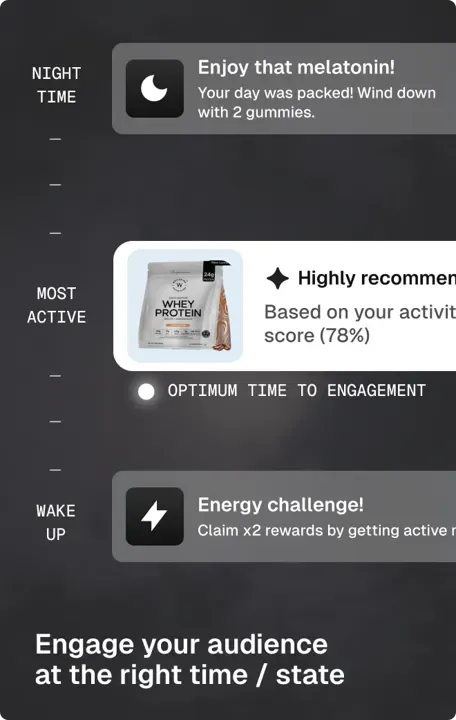
Side effects, cost, and fading motivation push patients off the medication and out of the program — and the weight comes back. Sahha surfaces the early signals between visits, so you intervene before they drop off.
Three reasons patients drop off — and you don’t see it coming.
01
They quit quietly, between visits
Discontinuation rarely starts with a phone call. Motivation fades, a side effect bites, the cost stings — and by the next check-in the patient has already stopped, or stopped showing up. The decision happens in the weeks you can’t see.
02
You’re blind until the next appointment
Programs run on monthly touchpoints and self-report, so you only learn how someone is really doing once a month — and only if they answer honestly. The early warning signs of disengagement live in the daily behavior you never get to see.
03
The scale demoralizes more than it motivates
Weight stalls, plateaus, and fluctuates for reasons that have nothing to do with effort. When the number is the only feedback, a normal plateau reads as failure — and a discouraged patient is one who quits.
What you build
Workflows you can ship with Sahha in days.
Catch disengagement before dropout
Insight
trend("activity").state
+
Insight
trend("wellbeing").state
→
Action
Flag patients whose activity and wellbeing are sliding between visits, and trigger a check-in before they quietly stop.
Tolerability context for titration
Tag
nausea
+
Insight
trend("sleep").state
+
Score
readiness.state
→
Action
Surface side-effect and recovery context between appointments so clinicians can time titration and outreach to how the patient is actually tolerating treatment.
Protect muscle with activity
Archetype
activity_level
+
Archetype
exercise_frequency
→
Action
Spot patients whose movement is dropping during the cut and nudge protein and resistance activity to preserve lean mass.
Non-scale progress through plateaus
Score
activity.state
+
Score
wellbeing.state
+
Insight
trend("sleep").state
→
Action
Show patients better sleep, steadier activity, and rising wellbeing when the scale stalls — keeping them motivated through normal plateaus.
How it works
One integration. Every health signal you need.
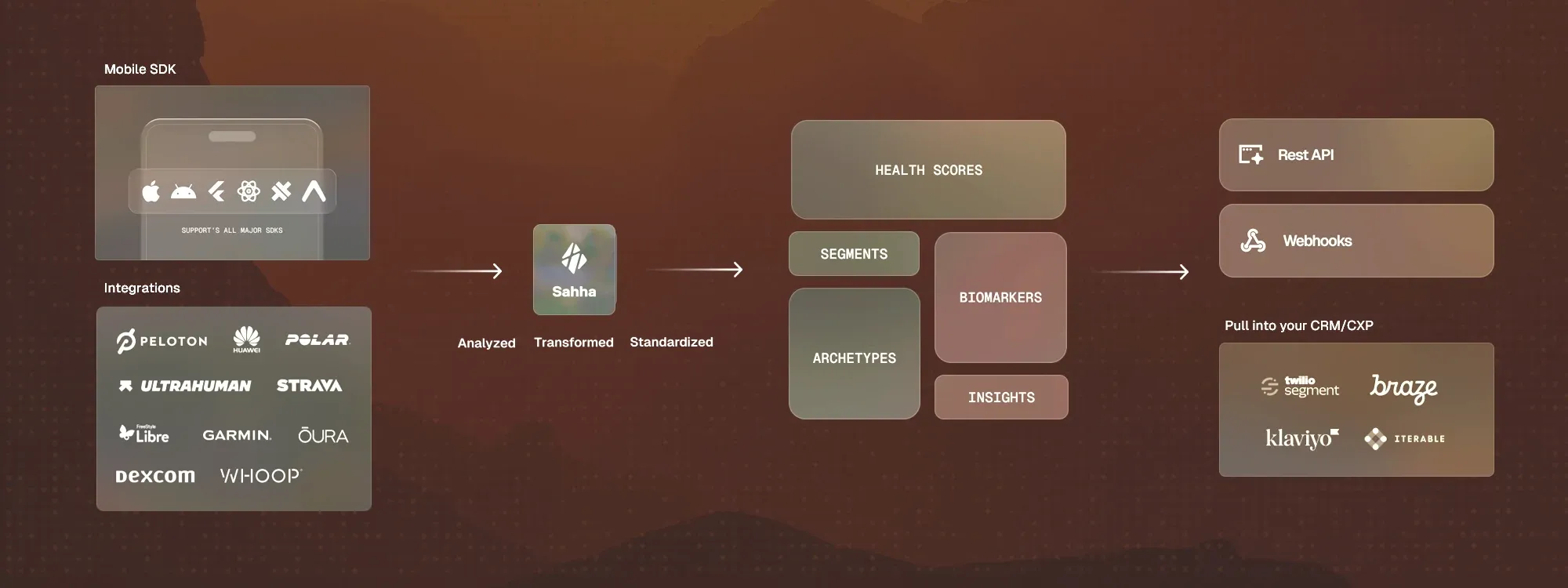
Step 1: Connect a data source. Drop the mobile SDK into your app to read HealthKit or Health Connect — or connect a wearable. No tracker required.
Step 2: Sahha turns raw data into signals. Raw samples become scores, archetypes, biomarkers, and insights — normalized and ready, with up to 30 days of history on connect.
Step 3: Build on the signals. Pull via REST API or receive real-time webhooks, then activate the signals across your product and stack.
Works without wearables
Read activity, sleep, and recovery from just a smartphone — no tracker to ship to patients.
Health intelligence
Scores, archetypes, insights, tags, and biomarkers out of the box.
Day-one history
Up to 30 days of data the moment a patient connects — a baseline from the first visit.
Real-time webhooks
New signals pushed as data lands — trigger outreach between appointments.
Fits your stack
Route signals into the tools you already use — Braze, Customer.io, Segment, and more.
Privacy & compliance
Explicit consent, and HIPAA, GDPR & SOC 2 compliance.
FAQ
Common questions.
Is Sahha a medical device, and does it manage dosing?
No. Sahha is not a medical device and does not diagnose, dose, or make clinical decisions. It surfaces consented behavioral and recovery signals — activity, sleep, readiness, wellbeing — that your clinicians and care team use alongside their own protocols.
Can Sahha detect medication side effects?
Sahha does not diagnose side effects. It surfaces context that often accompanies them — disrupted sleep, low readiness, dropping activity — and lets patients self-report symptoms like nausea as tags. Your care team interprets that context; Sahha never makes the clinical call.
Does Sahha track body weight?
Sahha is not a scale. It focuses on the behavior and recovery signals around weight change — activity, sleep, and wellbeing — which are the leading indicators of adherence and dropout. You keep using your own weight and clinical data; Sahha fills in the daily picture between those readings.
Do patients need a wearable?
No. Sahha reads data from the phone via Apple HealthKit and Google Health Connect, so you get activity, sleep, and recovery signals even for patients who have never owned a tracker. A wearable adds precision when one is connected, but it is never required.
How long does integration take?
Most teams pull live signals within days. You drop the SDK into your iOS or Android app, or call the REST API directly, and receive up to 30 days of history the moment a patient connects.
What does it cost to start?
The Sandbox tier is free for 30 days with every product unlocked and up to 25 development users — enough to build and test the workflows on this page before you talk pricing.
See it on your own patients.
Spin up the sandbox, add the SDK to your app, and start receiving live activity, sleep, and recovery signals between visits.