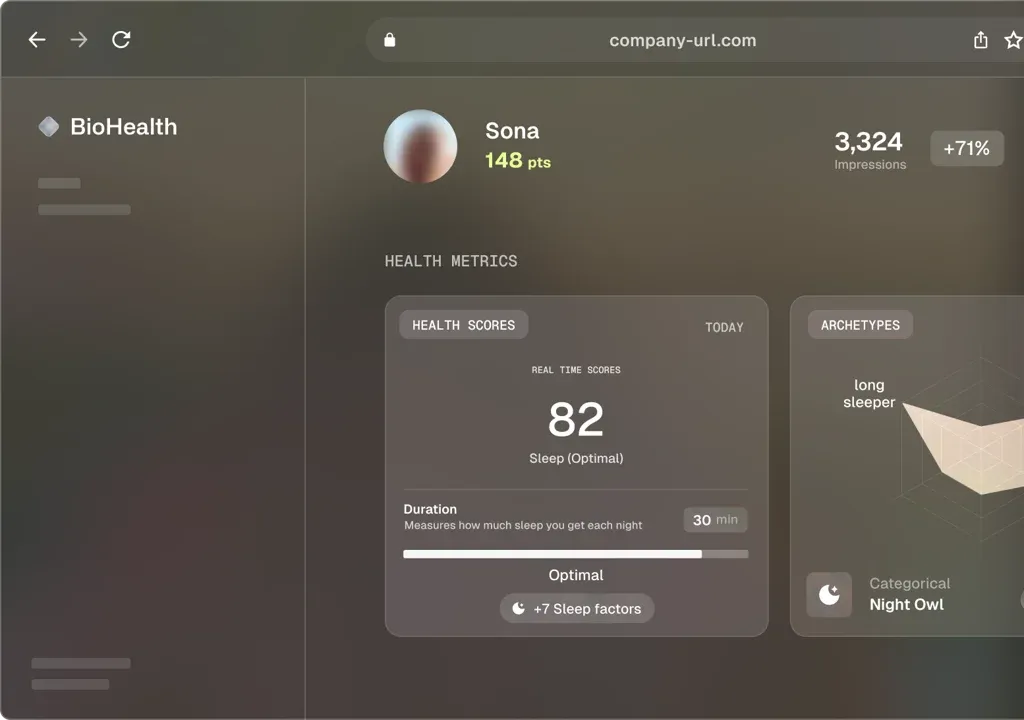
The rest is self-report — recency-biased and often wrong. Sahha fills the weeks between visits with passive activity, sleep, and recovery signals, so clinicians walk in already knowing how the patient really is.
Virtual care has no physical exam and no hallway read — just a 15-minute window and whatever the patient remembers to mention. Self-report is recency-biased and optimistic, so the picture you treat is the one the patient reconstructs, not the one their body actually lived.
02
You can’t tell who’s deteriorating
Panels are large and outreach is reactive. There’s no way to know which patient is sliding until they no-show, call in crisis, or quietly churn. Stretched care teams are left guessing who to reach this week.
03
You can’t prove it worked
Payers and employers want outcomes, but without objective, continuous data, engagement and improvement are just survey answers — the weakest possible evidence when a contract comes up for renewal.
What you build
Workflows you can ship with Sahha in days.
Between-visit patient context
Insight
trend("sleep").state
+
Insight
trend("activity").state
+
Score
readiness.state
→
Action
Give clinicians a continuous read on sleep, activity, and recovery between appointments, so the visit starts from data instead of recall.
Risk-based panel triage
Insight
trend("wellbeing").state
+
Score
mental_wellbeing.state
+
Tag
fatigue:severe
→
Action
Rank the panel by who’s deteriorating, so care teams reach declining patients before the no-show or the crisis call.
Care-plan adherence checks
Archetype
activity_level
+
Archetype
exercise_frequency
+
Archetype
sleep_regularity
→
Action
See whether behavior is actually moving toward the plan between visits, and nudge or escalate when it drifts.
Prove outcomes to payers
Insight
compare("wellbeing")
+
Score
wellbeing.state
→
Action
Track wellbeing before and after care and benchmark against population baselines, turning outcomes into objective data for renewals.
How it works
One integration. Every health signal you need.
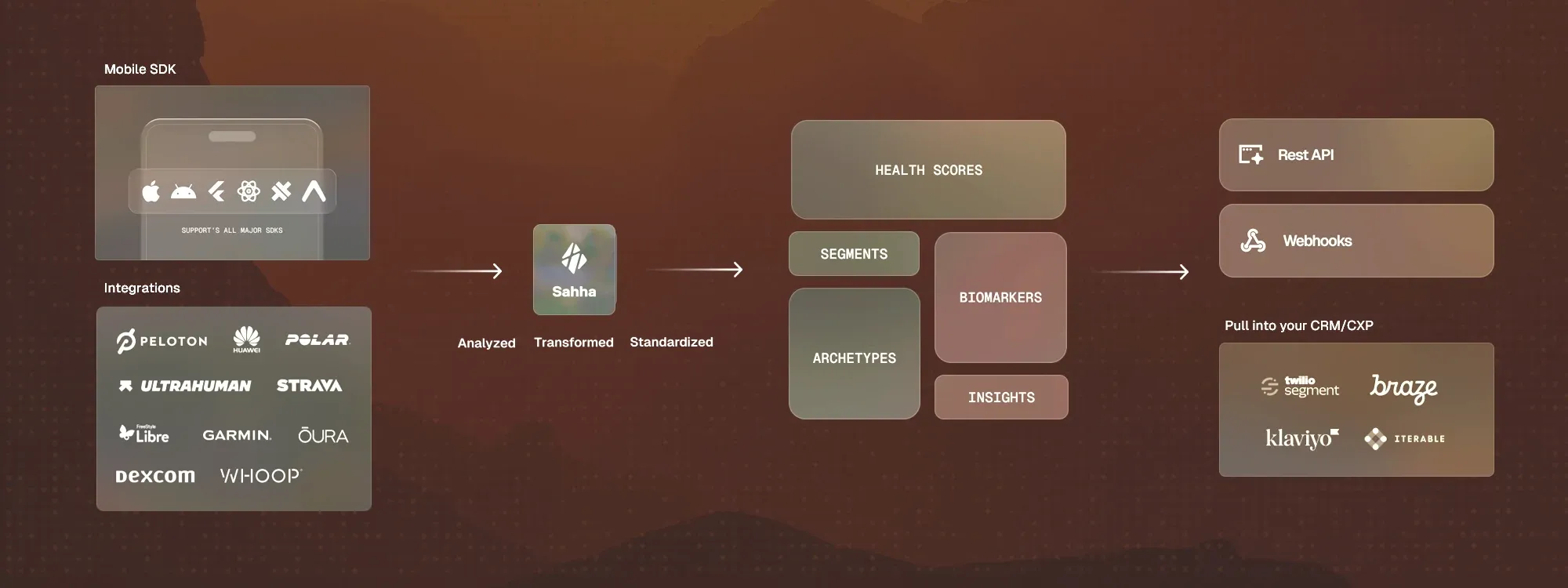
Step 1: Connect a data source. Drop the mobile SDK into your app to read HealthKit or Health Connect — or connect a wearable. No tracker required.
Step 2: Sahha turns raw data into signals. Raw samples become scores, archetypes, biomarkers, and insights — normalized and ready, with up to 30 days of history on connect.
Step 3: Build on the signals. Pull via REST API or receive real-time webhooks, then activate the signals across your product and stack.
Works without wearables
Read activity, sleep, and recovery from just a smartphone — no device to ship to patients.
Health intelligence
Scores, archetypes, insights, tags, and biomarkers out of the box.
Day-one history
Up to 30 days of data the moment a patient connects — a baseline before the first visit.
Real-time webhooks
New signals pushed as data lands — flag deterioration between appointments.
Fits your stack
Route signals into the tools you already use — EHRs, Braze, Customer.io, Segment, and more.
Privacy & compliance
Explicit consent, and HIPAA, GDPR & SOC 2 compliance.
FAQ
Common questions.
Is Sahha remote patient monitoring (RPM)?
No. Sahha does not measure clinical vitals like blood pressure, glucose, or SpO₂, and it is not a medical device. It provides the behavioral and recovery layer between visits — activity, sleep, readiness, and wellbeing — as decision support for your clinicians, alongside any RPM or clinical data you already collect.
Does Sahha diagnose or make clinical decisions?
No. Sahha surfaces consented signals and trends; your clinicians interpret them and make every clinical call. It is built to inform care, never to replace clinical judgment.
Do patients need a wearable?
No. Sahha reads data from the phone via Apple HealthKit and Google Health Connect, so you get activity, sleep, and recovery signals even for patients who have never owned a tracker. A wearable adds precision when one is connected, but it is never required.
What can I actually use without building models?
Five scores (activity, sleep, readiness, wellbeing, and mental wellbeing), behavioral archetypes, trend and comparison insights, symptom tags, and biomarkers — all from the same integration, with no data science required on your side.
How is patient privacy handled?
Data is collected only with each patient’s explicit consent, and patients can revoke access at any time. The platform is HIPAA, GDPR, and SOC 2 compliant, and you control exactly what you request and how it is used.
How long does integration take?
Most teams pull live signals within days. You drop the SDK into your iOS or Android app, or call the REST API directly, and receive up to 30 days of history the moment a patient connects.
See it on your own patients.
Spin up the sandbox, add the SDK to your app, and start receiving live, consented activity, sleep, and recovery signals between visits.